
UMass MedTech · Team project
PulsePal pediatric pulse oximeter
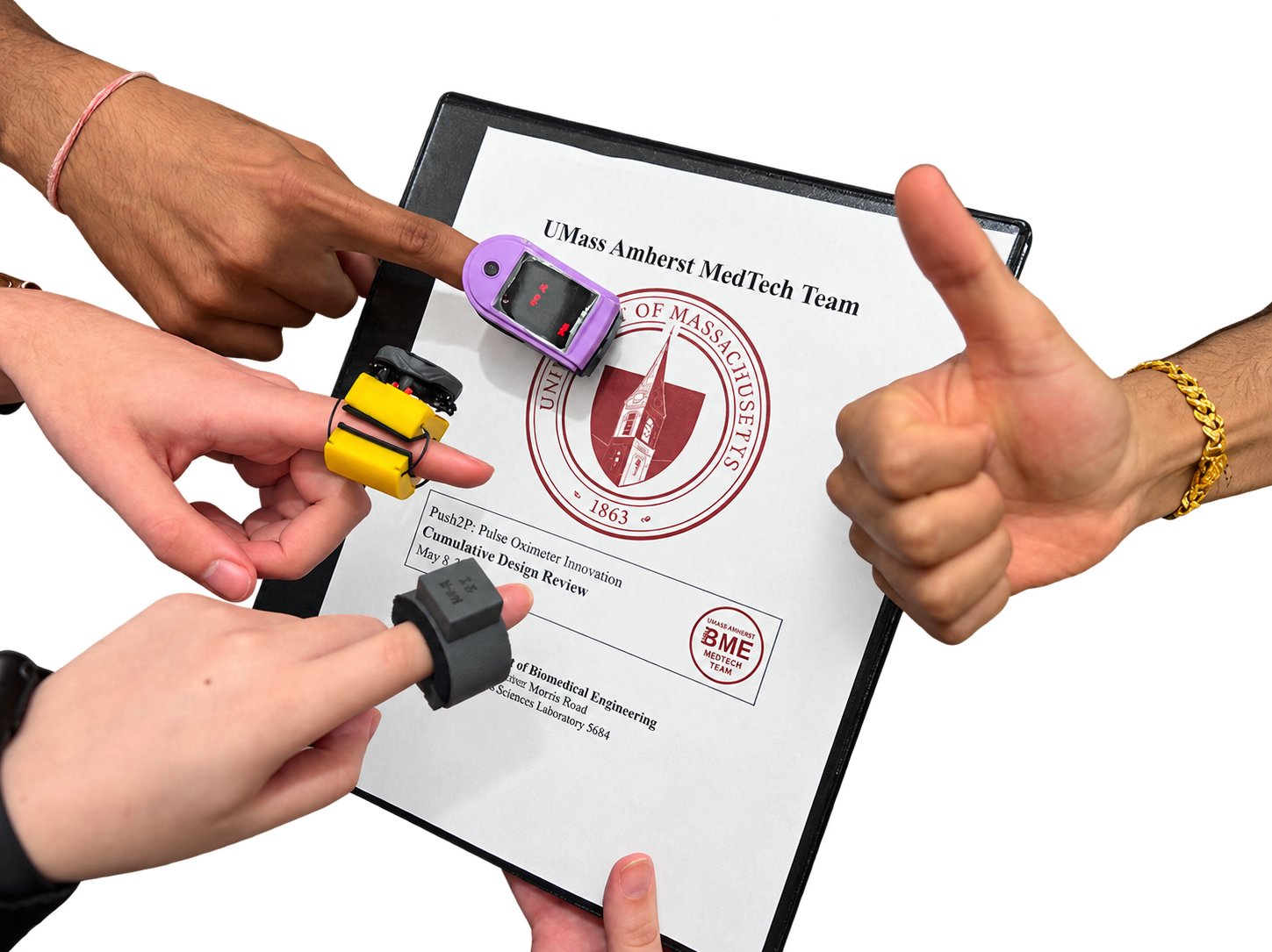
Two attachment prototypes: BOA vs. optode.
The project
A pediatric pulse-oximeter design project focused on reducing application time and improving attachment retention while maintaining comfort. The team developed two prototype concepts—the BOA cable-dial splint and the spring-loaded optode holder—and compared their mechanical attachment designs and evaluated comfort, perceived weight, mobility, and application time.
Two ways to improve the fit
The team developed a spring-loaded, cushioned optode holder and a two-piece splint with an adjustable BOA cable-dial mechanism. Both went through repeated CAD and 3D-printing iterations.
Learning from failed parts
Printed springs proved too rigid and difficult to fabricate at the required scale. The holder evolved to use replaceable mechanical springs, with six iterations addressing clearances, spring placement, and retention features.
What the user study found
In the May 2023 team report, college-student participants compared the two prototypes with a commercial pulse oximeter. About 65% preferred the splint and 35% preferred the spring-loaded holder; none selected the control as their overall preference.
These were human-factors findings from adult participants. The report describes the mechanical and electronic systems as separate at that stage, with integration and measurement-accuracy testing still to be completed.
Development priorities
The report identifies reducing the cost of the cable-dial mechanism, integrating the electronics, and evaluating measurement accuracy as the next steps.
Engineering lessons
Choose spring construction around stiffness and scale.
The printed springs were too rigid and difficult to fabricate at the required size. Using replaceable mechanical springs allows the spring and printed holder to be revised independently.
Treat attachment as a balance of retention and usability.
Comfort, mobility, perceived weight, and application time were all evaluated in the concept comparison. A secure attachment still needs to be practical to put on and comfortable to wear.
Validate usability and sensing as separate systems.
The adult-participant study provided feedback on the attachment concepts. It did not establish pediatric fit or measurement accuracy; electronics integration and signal validation remained separate development steps.
Use failures to reconsider the architecture.
Six holder iterations addressed clearance, spring placement, and retention. Replacing the printed spring changed more than a dimension: it separated elastic behavior from the printed structure. For later designs, identifying which function should live in a purchased component can make iteration more controlled.
Let user preference guide the next experiment.
The adult-participant comparison favored the splint, while the report still identified cable-dial cost and sensing integration as open work. Preference helps prioritize development; it does not close those technical questions. The next comparison should evaluate whether a lower-cost attachment preserves usability once sensing hardware is integrated.