
UMass MedTech · Team project
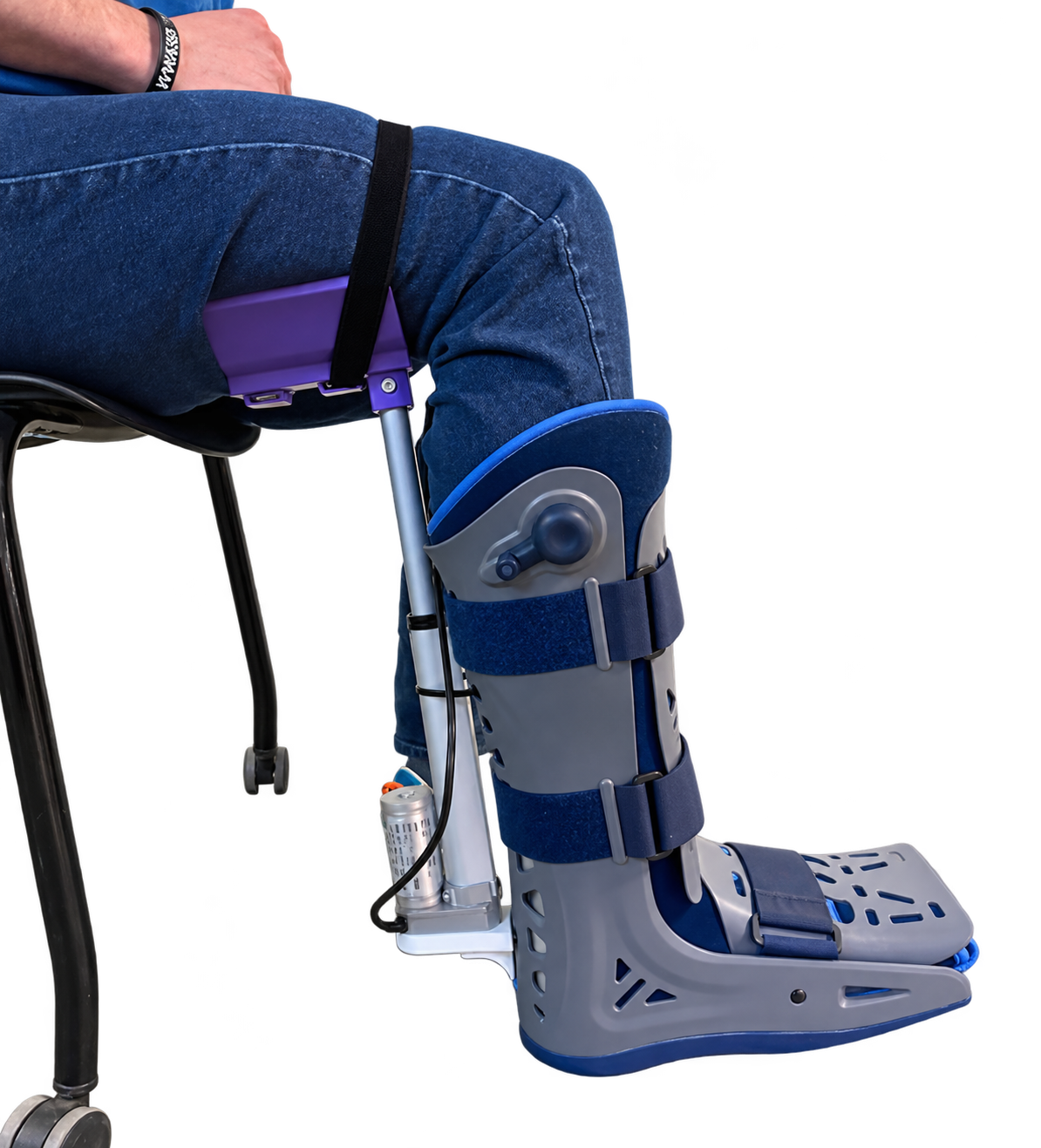
KneeVive traction therapy boot
2nd place at the UMass Tech Challenge.
The design challenge
After finding published research on knee traction therapy, I wanted to explore how that work could inform an at-home therapy device. The design goal was a non-invasive traction concept with adjustable, repeatable force.
My contribution
This was the first project I led as vice president of the UMass MedTech Team during my sophomore year. I led a 10-person team through design and prototyping, from the initial concept to a physical prototype, and designed the mechanical assembly.
Prototype development
We fabricated and tested multiple prototypes to evaluate force consistency and comfort while refining portability and manufacturability. The project won 2nd place at the UMass Tech Challenge and earned $2,500 for further development.
Engineering lessons
Adjustability and repeatability are different requirements.
An adjustable mechanism must also deliver force consistently. The prototype work considered both force consistency and comfort; a useful next test would check whether the same setting gives comparable force after the device is removed and refitted.
Include the body interface in the load path.
The traction mechanism acts through the boot and its attachment to the user. Fit and support therefore belong in the mechanical design alongside the force-generating assembly.
Evaluate comfort and mechanical performance separately.
A mechanism can deliver force yet remain difficult to wear or use. Keeping comfort, force consistency, portability, and manufacturability as distinct criteria makes prototype tradeoffs easier to assess.
Turn broad goals into separate prototype questions.
The team refined force consistency, comfort, portability, and manufacturability across multiple prototypes. Each goal calls for different evidence. A future iteration should define the question and acceptance criterion before fabrication so that a successful change in one area does not hide a compromise in another.
A concept milestone is a reason to sharpen validation.
Tech Challenge recognition and funding supported further development, but they do not establish therapeutic performance. The next design decisions should be driven by repeatable mechanical tests and appropriate evaluation of the body interface.